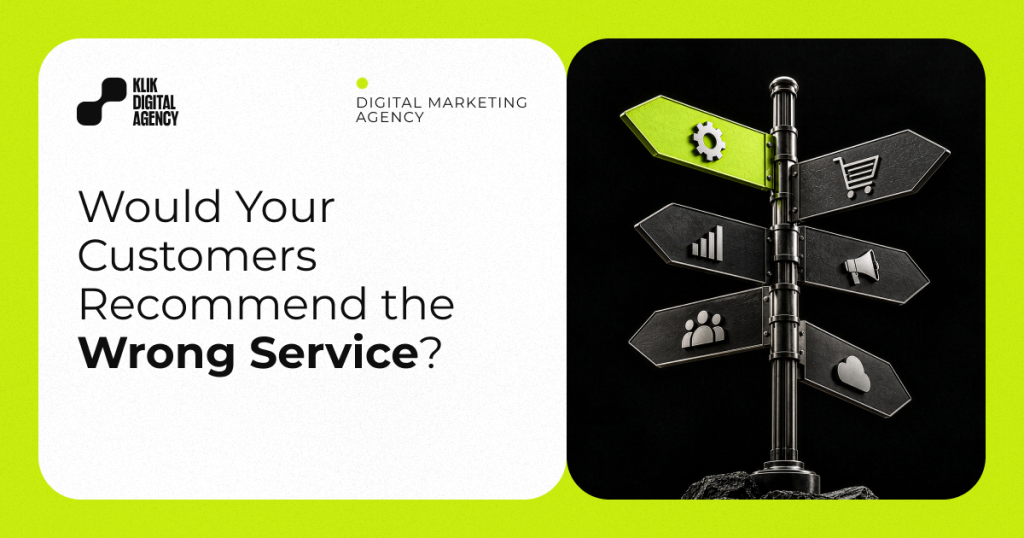
Imagine a customer recommending your company to a colleague, explaining that you can help with website design. The colleague contacts you only to discover that your specialty is SEO and conversion optimization, not building websites from scratch. You lose a potential lead, your sales team spends time clarifying the misunderstanding, and your customer continues recommending you for the wrong reasons.
This is an overlooked marketing problem: customers can be happy with your business and still struggle to explain what you actually do.
It often happens when companies expand their services, work across several specialties, or describe their expertise in language that makes sense internally but leaves customers guessing.
For business owners and marketing managers, the question is simple: if your customers recommended your business tomorrow, would they send the right prospects your way? The answer can reveal gaps in your positioning, website content, and lead generation strategy.
Here’s how to identify those gaps and fix them.
Why Good Customers Can Make the Wrong Recommendations
Customers rarely memorize a company’s complete service catalog. They remember the problem they needed help with and the experience they had.
A client who hired your agency to improve organic search visibility might remember you as “the team that fixed our Google rankings.” They may not realize you also offer content strategy, paid advertising, or conversion optimization.
Three factors commonly contribute to this problem.
Your business has changed, but your reputation hasn’t caught up. A company that started with website development might expand into SEO and paid advertising. Long-standing customers may continue recommending it as a web design agency because that’s how they first encountered the brand.
Your services overlap. An agency offering SEO, content marketing, website redesigns, and conversion optimization may leave customers unsure which service addresses their problem. Someone struggling to generate leads might recommend a website redesign when the real issue is poor targeting or an ineffective landing page.
Your messaging describes capabilities instead of customer problems. Terms such as “integrated solutions” and “strategic growth” can sound impressive without explaining when someone should contact you. If customers cannot connect your services to a recognizable problem, they have to improvise when describing your business.
The result is a gap between what your company can deliver and what its audience believes it can deliver.
Your Website May Be Sending Customers in the Wrong Direction
Your website is often where potential customers go to learn more about a business someone has recommended. It should help them recognize their problem, understand your offer, and choose the right next step.
However, visitors don’t necessarily explore every page to work out what you do. They make quick judgments based on headings, service names, and descriptions.
Consider these examples:
- A page called “Growth Solutions” discusses paid advertising, but visitors assume it covers SEO, too.
- A service page promises more leads but focuses on website traffic without explaining how the company approaches conversions.
- A website lists SEO, content strategy, and web development without explaining which service would best address declining organic traffic.
Each element might make sense on its own. Together, they can leave visitors with an inaccurate picture of your expertise.
Google’s SEO Starter Guide emphasizes creating helpful content and organizing websites so people can find relevant information. Clear service descriptions support that goal by helping visitors understand what your business offers and whether it fits their needs.
When people cannot identify a relevant service, they may choose an unsuitable option or leave without realizing your company could help them.

The Hidden Cost of Misunderstood Services
This confusion affects more than website navigation.
Unqualified leads consume sales time. When prospects misunderstand your offer, your team must explain what you do before determining whether there’s a genuine opportunity. A few mismatched inquiries are normal, but recurring confusion may indicate a messaging problem.
Customers overlook services they need. An existing client might hire another provider for SEO because they know your agency for paid advertising but don’t realize you offer both. Your company misses an opportunity to expand the relationship.
Expectations become misaligned. A business owner might commission a website redesign expecting an immediate increase in qualified leads. The new site may look better, but if the underlying problem is poor targeting or a weak offer, a redesign alone may not solve it.
Clear positioning helps customers understand what a service can accomplish, what it includes, and when another approach might be more appropriate.
How to Find Gaps in Your Service Messaging
Start with information your business already has.
1. Review the questions prospects ask.
Look at inquiry forms, emails, and sales call notes. Do prospects repeatedly request services you don’t provide? Do they misunderstand the scope of services you do offer? Recurring questions may reveal information your website should communicate more clearly.
2. Examine why leads are disqualified.
If your customer relationship management (CRM) system records why opportunities don’t progress, review those reasons. Separate leads outside your target market from those that misunderstand your capabilities. If you’re attracting the wrong audience, targeting may need work. If you’re attracting the right audience but they expect a different service, messaging may be the bigger issue.
3. Ask customers to describe your business.
Choose several customers who know your company well and ask:
- How would you explain what we do to a colleague?
- What problem would make you recommend us?
- Which services do you think we offer?
Don’t show them your official service descriptions first. Their responses can reveal gaps between your intended positioning and what customers actually remember.
4. Test your website with someone outside your industry.
Ask a colleague or customer to imagine they have a specific business problem and find the service they would contact you about. Watch where they click and what they misunderstand. A service name that feels obvious to your team may mean very little to a first-time visitor.

How to Make Your Services Easier to Understand and Recommend
Once you identify the gaps, focus on making your positioning consistent across the places where customers discover and evaluate your business.
Describe services through the problems they solve.
Compare these descriptions:
- Less clear: Digital growth solutions.
- More useful: SEO and content strategy to help customers find your business through organic search.
Or consider:
- Less clear: Conversion optimization.
- More useful: Improve the percentage of website visitors who become leads or customers.
The goal is to explain what a service means, who needs it, and what the engagement involves.
Google’s guidance on helpful, reliable, people-first content reinforces the importance of creating content for the intended audience rather than publishing pages simply to attract search traffic.
Explain the differences between related services.
If your agency offers SEO, paid search, and conversion optimization, explain when each may be appropriate.
SEO helps businesses improve organic search visibility over time. Paid search reaches relevant audiences through advertising campaigns. Conversion optimization focuses on increasing the proportion of visitors who take a desired action.
These services can complement one another, but they solve different problems. A comparison page, FAQ, or decision guide can help prospects understand where to start.
Keep your marketing consistent.
Review your homepage, service pages, search listings, social media, and sales presentations. Each channel doesn’t need identical wording, but they should communicate the same underlying value.
If your website presents you as a strategic marketing partner while your social media focuses almost entirely on design, customers may receive mixed signals.
Use customer questions to create content that clarifies common misunderstandings. An article explaining when a business needs a website redesign versus conversion optimization, for example, can help prospects understand their options before contacting your team.
Finally, track whether the changes make a difference. Monitor qualified inquiries, recurring sales objections, service-page conversions, and referrals that produce relevant opportunities. Review these patterns with your sales team instead of relying on website traffic alone.
Klik Digital can help you identify where your messaging loses clarity and build a digital marketing strategy around how customers search, evaluate, and choose services. Contact us to discuss how your website and content can connect the right customers with the right services.